Membership Policies


Membership Policies

Members must be 18+ to participate in group classes and open gym. Memberships are non-transferable between members.

Tardiness
To support your safety, class flow, and fair check-in and waitlist management, we ask that all members arrive on time. There is a 10-minute grace period; after that, you won’t be allowed to join class. If you’re late, you’re welcome to transfer to a later class (if space allows) or use Open Gym instead.

Arriving Early / Staying Late
If you’re registered for class, you’re welcome to use available space in 597 or 608 for any pre- or post-workout training. Just be mindful of others and ongoing classes.


RSVPing to Class & Waitlist

All gym visits must be reserved in advance through the Zen Planner Member App. Group classes are listed by start time; Open Gym appears in blocks—you can arrive anytime within the block. You do not need to leave at the end of the block unless a class is about to begin and needs the space. All members must check in at the Front Desk upon arrival.

How to Register:

  1. Download and log into the Zen Planner app.
  2. Tap Calendar and select your class.
  3. If your membership is valid for the class, tap the blue Reserve button.
  4. View your reservations in the calendar (starred) or under your profile in the Reserved tab.

Reservations open 7 days in advance. Please cancel as soon as you know you can’t attend to open space for others.

Waitlist Instructions
If a class is full, you can join the waitlist. If a spot opens, the first person on the list will receive a text with a 1-hour window to confirm.

To claim your spot:

  1. Open the Zen Planner app and tap Yes, Confirm My Spot (or No, I Won’t Attend).
  2. If no confirmation appears, you may need to cancel an existing RSVP due to weekly limits.
  3. If the pop-up doesn’t show, try fully closing and reopening the app.

During the 1-hour window, your status will temporarily show as “Reserved,” but your spot is not secure until you confirm. If you’ve claimed a class, please remove yourself from other waitlists to free up space for others.


Class Cancellation & Transfer Policies

To keep classes accessible to all members, we enforce cancellation policies to reduce no-shows and late cancels, especially during high-demand times.

Members who cancel after the deadline will be charged a $15 fee.

Cancellation Deadlines:

  • 6:00am–9:00am classes: Cancel at least 10 hours before start time
  • 10:00am–7:30pm classes: Cancel at least 5 hours before start time
Emergency Credit

Each member is allowed one emergency credit per quarter to waive a $15 fee. To use it, email cfsbkfrontdesk@gmail.com within one week of the missed class. No explanation required. Credits do not roll over.

Same-Day Class Transfers
You can avoid a penalty if you:

  • Move off a waitlist into another class the same day
  • Switch from a class which is not full to another class the same day

To do so:

  1. Cancel your current reservation in the app
  2. Contact the Front Desk to let us know about the switch

Rolling Reservations for Longtime Members
Members with 5+ years at CFSBK are eligible for limited rolling reservations, which automatically reserve spots in select classes as a thank-you for their loyalty. These reservations follow the same cancellation policy and are capped to keep access fair for all.


Membership changes, holds and refunds

Upgrades & Downgrades
You can upgrade or downgrade your membership anytime. Remaining balances will be applied to your new plan, and your membership date will reset. All future reservations will be lost, so give 7 days’ notice if possible. Contact the Front Desk to make changes.

Holds
Memberships can be put on hold for 1 week–3 months with at least 3 days’ notice. Holds extend your billing cycle. Any reservations during the hold must be manually removed.

Cancellations & Refunds
You can cancel anytime without fees by contacting us (not by deleting payment info). Let us know at least 3 days before your next bill or cancel instantly on the desktop version of Zen Planner. We don’t offer refunds for late cancellations or unused sessions.


Discounts

12% discounts available for: full-time teachers, students, FDNY, EMT, DOS, social workers,  armed services. CFSBK also offers pay what you can memberships for those who cannot afford our posted rates. To learn more about this program, check out our Scholarships page


Open Gym and early access

Open Gym Guidelines
Always RSVP and check in before training. Use one rack/station, store your gear off the floor, and clean up after yourself. Wall timers are for staff only. Certain racks are reserved at specific times (posted by racks). Watch our Open Gym video before attending. Learn more here.

If you’re registered for a group class, you’re welcome to use available space in 597 or 608 for any pre- or post-workout training. Just be mindful of others and ongoing classes. No additional RSVP needed

Hybrid AF Access
Members with Hybrid AF access may enter via the side door starting at 5am weekdays / 6am weekends. Always RSVP in advance. Turn on fans/lights if you’re the first in and secure the space when leaving. Wi-Fi use is restricted to prevent system crashes. Learn more here.


Dogs, Kids & Bikes

We’re proud to be a kid- and dog-friendly gym, but safety and focus come first. If you plan to bring a child or dog, please follow the guidelines below.

Kids

  • Only bring kids when necessary
  • No kids on the gym floor or equipment
  • In 597 kids may stay on the couch near the front desk
  • In 608 kids must stay in the station with their guardian
  • Staff are not responsible for supervising children
  • We may ask you to attend to or remove disruptive children

Dogs

  • Dogs must be leashed and calm (No barking, whining, or biting)
  • In 597 dogs may be leashed to the bottom of the stairs
  • In 608 dogs may be leashed in the station with their guardian
  • No dogs on the gym floor or unleashed
  • We may ask you to remove disruptive dogs

Bikes

  • Non staff bikes are not allowed inside the facilities—no exceptions
  • One loaner bike lock is available at the Front Desk if you forgot yours
  • Scooters/skateboards are okay; store near coat racks

Thursday 9.24.20

Virtual Class Zoom Room (Password: CFSBK)
Yoga in the Park: 7am
Pilates Happy Hour: 6:00pm
Kids: 4:30pm


Workout of the Day

STRENGTH

Bench Press
10-10-10

Notes:
Work up to three sub max heavy 10s. You should have 2-3 reps in reserve every set. Don’t use clips on your bar just in case.

METCON

EMOM 15:00
A: 15-20 Wall Ball Shots
B: 15-20 Push-Ups
C: 15-20 Box Jumps

Notes:
5 Rounds of each movement.
WB: Choose a weight, height and rep range that will make this into one challenging unbroken set. 25/20/14/10
PUSH: Challenge your muscle stamina. Each round should be difficult but doable in 1-4 sets. If needed do a hybrid of strict and knee push-ups.
BJ: Step Down (24″ / 20″ / 16″)


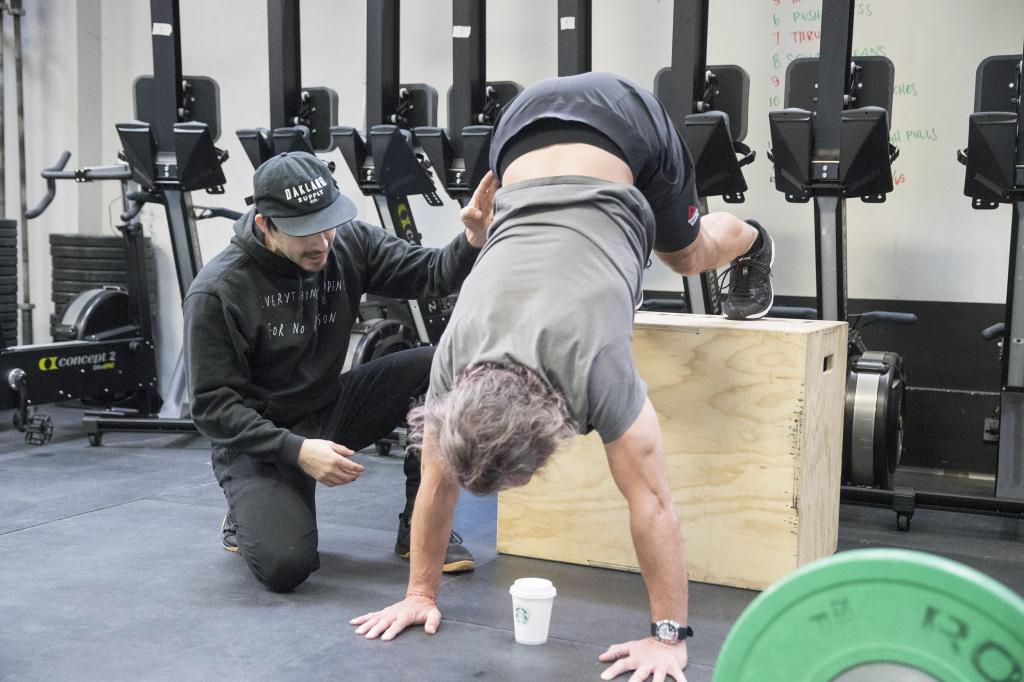
Coach Ro working with Aaron on some weighted pull-ups

The CFSBK donations for Operation Backpack are still rolling in! We’re over 2.5x our goal of $1,000 with $2,607 raised as of yesterday evening. Thank you!!!

Yoga in the Park Today

Join Coach Whitney this morning at Prospect Park for some outdoor Yoga!

Yoga @ 7AM, near the Bandshell

What to bring: Your mask and your mat! Possibly some bug spray.

Weather plan: There’s almost no chance of rain. But if anything changes, I’ll email again here and post to the CFSBK blog comments.


Running a Gym in 2020: CrossFit Hyperactive

Sunday 8.16.20

CFSBK Zoom Room (Password: CFSBK)
Active Recovery: 10am


A New York Decade

This article was originally published in the CrossFit Journal on January 29th, 2018. It was an interview I did in Santa Cruz with Andréa Maria Cecil.

More than 10 years ago, a 22-year-old David Osorio became the proud owner of a CrossFit affiliate.

He started training people at 7 a.m. on Sept. 19, 2007, at St. Mary’s Playground in the Carrol Gardens neighborhood of Brooklyn, New York. The affiliate’s first workout was 5 rounds of 30 seconds at each of the following three stations: body-weight rows, 50-m sprints and PVC thrusters.

“I had known that I had wanted to own my own gym since I was 17. That was my plan,” Osorio recently explained during a visit to CrossFit Inc. in Northern California. “And I knew that I wanted to do something different and special and kind of community based and inclusive. But I didn’t really know what that was. I just knew that the model of gym that I was familiar with—that was not what I wanted to be, where people just sort of come in and do their own thing.”

Four years earlier, as Osorio pursued a degree in exercise science from West Chester University in Pennsylvania, he worked as a personal trainer at a local YMCA. There, a police-officer buddy told him about CrossFit.com. That was in 2003. Osorio dove in head first.

“I think I got a better education watching all the old videos and (CrossFit) Journal articles than I did in four years of college. It was just so intuitive. (I was) like, ‘Yes, this is it. This is exactly what I’ve been looking for.’”

He hatched a scheme: finish his degree, move to New York, open a CrossFit affiliate.

“And so I did.”

Today, CrossFit South Brooklyn is a thriving affiliate with classes tailored to its growing membership. These offerings include yoga, powerlifting and Olympic weightlifting, as well as classes dedicated to postpartum mothers, people who are 55 and older, and children. Over a decade, Osorio has solidified the foundation of what’s important to operating and growing such a business. The answer will be familiar to longtime members of the CrossFit community: Doing the right things for the right people for the right reasons.


Andréa Cecil: What was it like owning a CrossFit affiliate in 2007?

David Osorio: I started in the park with some equipment that I had made—some sandbags—some tires that I’d found, other things I could transport and some jump ropes. It was small. The only affiliates in the area were me and CrossFit NYC.

It what was easier then. It’d be harder to replicate it now just because there’s so many affiliates, there’s so many expectations of what an affiliate is. But back then it was like, “Oh, this is what CrossFit is—a dude in the park. OK, sure.”

The essence of what it was then is extremely similar to what it still is now. The classes back then would still be recognizably a CFSBK class in terms of what we do: question of the day at the start of class, then movement prep. Obviously, we were limited back then by lack of equipment and a facility, but I didn’t really see those as significant obstacles. People showed up and I would act as if I had a 10,000-square-foot facility. I was very matter of fact and people were on board. It was different. Over the 10 years a lot has changed, but the most quintessentially important things have remained the same in terms of how we nurture our members, the attitude we take, the humility we have. It hasn’t changed significantly in the ways that are most important.

ALT TEXT“I always let demand dictate my need to expand. I wouldn’t preemptively do big expansions or big equipment purchases.” —David Osorio

What prompted the move from the park to an indoor space—growing membership?

It was like 10 of us. But it was cold. It was New York. It’s December—people aren’t going to keep coming outside. I luckily found this place called the Brooklyn Lyceum. It was sort of a performance-arts space. It had these two floors. Each of them was about 5,000 square feet. It was kind of a rag-tag building. It was kind of falling apart, dilapidated in a lot of ways. But I was paying 25 bucks an hour, so if I got two people, I could make my money back on the hour. The owner gave me a little corner where I could put my equipment.

At the park, I was doing 20-dollar drop-ins. And I had saved enough money from the park that I could get some more equipment—some kettlebells, a couple barbells, some bumpers. Just very organically and gradually, it began to grow. One of the special things about starting in a park—starting so small—is that not only is it fun to progress but the members internalize the growth. They’re like, “We have a kettlebell now!” Everyone’s excited about that. It’s a win for the community. Every small, little step meant a lot to a lot of people, and they could see the affiliate growing. They could see: “Hey, I’ve been here for three months and now we can actually bench press. We have more jump ropes, we have this, we have that, we have another class.”

I always let demand dictate my need to expand. I wouldn’t preemptively do big expansions or big equipment purchases. I would ask myself, “What can I afford? What do we need most?”

When you moved to the Lyceum, were you running classes all day?

I started with between two and four classes per week. I was still working at Equinox to pay my own bills and support myself. Everything that the program made and everything that I could save additionally from my job at Equinox as a trainer, I would just funnel back into the gym. And when those handful of classes started to be consistently attended, I would add a class. I would just do that very gradually as demand warranted.

For the first four years plus, we had an honor-system membership that was 20 bucks. We had a little pencil pouch with a note that said, “Please leave $20.” We didn’t have any contracts, any memberships. It was just 20 bucks when you showed up to class. I look back now and our drop-in rate’s 25 dollars now. I think I’ve only raised prices once in 10 years because I felt confident I was providing a valuable service to people. I really felt like, “Even though we’re in a park or in this kind of dilapidated facility, members are getting the best.” And I coach with that attitude. I never was apologetic or thought “this is not sufficient.” When you take that attitude, people align with it.

Even when we moved into one of our current facilities, it included a desk someone had donated to me and the little pencil pouch with “Please leave $20”—people really found it sort of endearing. Every now and again someone would say, “I don’t think I’ve paid you in a couple of months.” And I was like, ‘All right, well, whatever you think you owe me, throw it in there.’” That really resonated. Now we have different membership rates and recurring monthly memberships. But we don’t do any long-term contracts. I came from a fitness background—the commercial fitness industry—where it’s hard to cancel your membership. You have to give them, like, three-months’ notice and then you have to sit in the sales office and they give you the hard sell. And I just hated that. I don’t want to sell memberships. I want to be a coach, and I want to have community. If I have to talk you into what we’re doing, then I’m not interested. Maybe this isn’t best for you.

ALT TEXT“I don’t want to sell memberships. I want to be a coach, and I want to have community.” —David Osorio

We’re very flexible with our memberships in terms of not locking people into things. We’re very, very liberal with that. People really, really respect that. If you don’t want to come, there’s no financial obligation for you to come. People really like that. I’ve heard that a lot, where people are like, “I’ve never been to a gym where it’s an honor-system membership.” I think that speaks to the nature of the gym. Like, “Hey, we’re a family. If you’re in here, we’re gonna treat you like family. We’re gonna treat you like a member of the community. You’re not a client. You’re not a customer. You’re a member.”

In the beginning, when it was just me and one or two coaches, people had that ethical incentive to pay membership dues because “I want these guys to succeed. I want the gym to grow.” They’re invested emotionally in what we do.

Do you think an affiliate could start in a park today?

I think it would be much harder. You’d really have to leverage your personality, your coaching experience. When I started, I had already been coaching for several years. I had been personal training, I had my degree in exercise science, I had been doing this. So, I wasn’t green. I think that came across. I think if I was just some Joe Schmo in the park doing whatever, people would have thought, “This is not worth my time.”

Every situation’s different. I think you can make it work. But, again, you really have to leverage your own personality, your own coaching abilities, your ability to foster community. There has to be an emotional connection that draws that person back if they’re gonna come out on a cold day to the gym. Is it possible? I don’t know. I mean, I think it’s possible, but it’s harder now. It’s definitely harder now.

The only other thing I’d say is I think it’s less of a risk to go in on a space at this point, meaning back then it was like nobody knew what CrossFit was, and if I had one person per month asking “hey, what’s this thing about?” that was a lot. But now CrossFit’s more ubiquitous and there’s an expectation. There’s less financial risk. I did it because no one knew what this was. And I thought, “I’m not going to be able to buffer this.” I don’t have a business background, so in the beginning I was going with no partner, no investors, no loan, no debt—just completely bootstrap it because it has to have its own legs. It’s not like I’m gonna take a risk and hope for the best. If I have more equipment and more members, it’s because I’ve earned them.

ALT TEXT“Back then it was like nobody knew what CrossFit was, and if I had one person per month asking ‘hey, what’s this thing about?’ that was a lot.” —David Osorio

Tell me about the CrossFit South Brooklyn blog.

We’ve always been active on the gym blog. It’s been part of how we cultivated community and set the tone of our culture. That’s been a huge, huge part of it. It’s basically a scrapbook. Every single workout we’ve ever done—and rest days—we’ve posted on the blog with a picture from the gym and some links.

I tried to replicate the model I saw on CrossFit.com at the time—which got me so enamored with CrossFit in the first place. Our blog was a micro version of that in our own community. From early on, people would be on the blog, commenting. Again, it was like a scrapbook, so you can see over time, “Oh my gosh, we got one rower!” And it was this huge thing. We were so excited that we had a rower. And we were, like, a legit CrossFit gym now.

What are notable differences in operating an affiliate in 2007 and now?

Change is inevitable. You’re gonna have people who are like family, and they’re gonna come and go, and that’s the natural process of things. If you have strong values within your affiliate, that’s the most important thing—offering special services, being inclusive, being fun, being safe, being clean. But change is inevitable. If someone leaves your gym, you can’t take it personally.

Diversifying your programs is important because we’ve had members who have been with us for eight-plus years, and part of what keeps them there is there’s a lot to keep them stimulated. We have a variety of classes that we offer, specialty classes—from yoga to Pilates to StrongFit to powerlifting to Olympic lifting. It becomes this physical-culture hub where people come in and they’re like, “There’s so many things happening here. It’s so diverse.” We have masters programs, we have kids programs, and that diversity really enriches your gym. It enriches your community and it makes a space for everybody. So, when someone comes in, they might say, “Hey, I wanna try CrossFit but I’ve always been really curious about Olympic lifting as well.” We can have you do a hybrid program with an Olympic-lifting bias. I teach the intro class every weekend, and that’s one of the things that I highlight—that we have all these different programs. That’s a big thing for a lot of people—“Oh, wow, there’s a lot for me here.” It’s a really stimulating environment and a diverse environment.

The other thing is I came from the commercial fitness industry, and in most commercial training gyms there’s a lot of turnover. There’s a lot of people who are hobbyists who say, “Oh, I’m an actor but I’m doing this on the side. I’m moonlighting as a trainer to pay my bills until my big break.” I was always of the mindset that this is a career. So, I’ve tried to create an environment that I would want to work in—that was important to me. Would I work in this gym? Would I stay here? For our full-time coaches, the gym pays 80 percent of their health insurance. We have a health-insurance plan; we have a 401(k) plan, which we are matching; we have maternity/paternity leave; we have paid vacation; we have bonuses. You attract and retain good people if you make it hard for them to leave. And it feels like a career. A lot of times, affiliate owners will say, “OK, we need coaches. Who wants a free membership?” Coaches are ambassadors. During every class, every coach is an ambassador for your gym, and you can’t rely on people who are hobby coaches to run a successful program if you wanna be around for 10 years. I’m able to take a week off, and I don’t worry about what’s happening at the gym because I know that everyone is taken care of. People are there who are professionals who care about the gym, who think of it as a career rather than just a job.

ALT TEXT“We have masters programs, we have kids programs, and that diversity really enriches your gym. It enriches your community and it makes a space for everybody.” —David Osorio

Do you think it requires a certain number of members to make that happen?

I don’t know what that number is, but I would say you have to show your coaches that you’re investing in them. And to have those conversations: “What do you need from the gym?” And then having an honest answer of “what can I actually give you?” What I hear is there’s a lot of ambiguity there. Like, “Oh, I’m just a part-time coach at this gym. I don’t really know where my career is going, if I’m going to be here for that long or what they can offer me.” It’s being honest with people and saying, “If you’re willing to invest in the gym and you can run classes well, maybe pick up some other administrative duties”—or whatever they might be interested in doing. It shows them you care.

It’s important when you work somewhere to feel like the company’s invested in you. From a small gesture of “hey, why don’t you take the week off? I’m gonna still pay for the classes you would’ve worked.” Whatever you can do. As you go—and all the other things are in place—you can begin to offer those more professional career incentives. Go toward that because that’s the best investment: your coaches.

What’s your single best piece of advice for young or rookie affiliates?

Investing in your coaches. And choosing them. Someone shouldn’t be a coach just because they said “hey, I wanna be a coach” and they’re a hotshot CrossFitter. You can teach most people how to coach. You can’t teach someone social skills or empathy. And you can’t teach someone what it really means to be in the service industry, to serve people. Identify the people in your community who have those inherent values and characteristics and then try to bring them up as much as you can.

I was just talking to someone who is a coach at an affiliate and she was really frustrated because there’s a lot of ambiguity about “where am I going with this? I teach these classes but there’s never a conversation (about) ‘where do you see yourself in five years? Where do you see yourself in two years? What do you wanna do with this? Do you wanna grow? Are you happy just doing what you’re doing?’” And the longer you do that, the more turnover you have. It’s hard to run a business with a lot of turnover. I would say make it a business that you would want to work in. If you weren’t the affiliate owner, would you stick around? If not, why wouldn’t you? What can you do to resolve that?

And you have to stay excited about it. You can’t get over it. You can’t be, like, too cool for school about it. You can’t be blasé about it. I still get excited to run intro class. I teach our free intro class every week. I love meeting people and giving them their first exposure to CrossFit. I like working with all our programs. I still coach a lot. I still do a lot of personal training. I take our group classes. I really want to be in the gym’s DNA. I’m not doing this so I can step away from it and not think about it anymore. I really enjoy the process. I enjoy taking classes and seeing what our members are experiencing. I really enjoy working with a variety of different people. It’s not a ticket for me to stop working; I’m creating an environment that I want to work in.

ALT TEXT“I had a lot of confidence in our product. I had a lot of confidence in myself that I could give people a professional, inclusive and effective experience.” —David Osorio

Did you envision growing CrossFit South Brooklyn to its current size?

I didn’t have a specific number ever. I knew I was going to be successful. That was the plan: To be successful. It was never, “oh, if I hit X number of people, I will have achieved my goal.” It was, “how big can I make this while maintaining the quality and the integrity that is essential to making the thing worthwhile?” So, it’s like if it got to a point where it’s like, “Man, classes don’t run on time, and no one knows each other, and the coaches are tuned out, and it’s this revolving door of members,” but I have 1,000 members, that doesn’t mean you’re successful—despite the membership number.

For me, expanding was responding to the demand. Same thing when we were in the park, same thing when I was in the Lyceum. It was like, “OK, there’s demand for more space, more programs. What can we do to facilitate that?”

I had a lot of confidence in our product. I had a lot of confidence in myself that I could give people a professional, inclusive and effective experience. “We’re going to keep growing this thing as long as people want to sign up for it”—that was the plan. I didn’t want to say, “OK, I just want this little gym with 100 members and I’m good to go. That’s all that I want.” As long as we keep growing, I’m going to keep doing whatever I can—bending over backward—to maintain the integrity and the quality of the program. I don’t have a goal. The membership number—that’s the result. The important thing is the focus and the integrity and all that stuff. The membership size is just a byproduct.

There’s some parallels between ecology and running a CrossFit affiliate, maybe any business. In an ecosystem, there’s something called “carrying capacity” for a particular population. If this room is a garden, it might be limited to just the available square footage, the biodiversity of the plant that an animal is feeding on. So, what can we do to increase our carrying capacity? Maybe it’s space, maybe it’s more equipment, maybe it’s playing with the hours, maybe it’s having more coaches. My philosophy has always been assessing what the carrying capacity is, and if there’s a demand for more, what can we do to increase that carrying capacity—again while maintaining the vision of what we’re trying to create.

How do you go about managing so many members?

It’s the culture of the staff—our front-desk staff to our coaches to our cleaning staff. People feel an emotional ownership of the gym, so they have a personal investment in doing right by people. It’s a million little things. It’s like I walk into the bathroom; I notice some toilet paper on the floor. I’m gonna pick it up, throw it out. Or the toilet seat is dirty; I’m gonna wipe it down. Or someone comes in, they look a bit confused. I’m gonna walk over and start a conversation with them, make sure they know what’s going on. It’s these constant little gestures and practices that you do. You know, 850 (members) doesn’t seem that different than 300. It doesn’t feel that different to me because we do the same thing.

ALT TEXT“You don’t want a watered-down program. So you create those options, those tiers for people to engage in the program at the level that’s appropriate for them.” —David Osorio

How do you address athletes’ varying skill levels within the same class?

We have leveled programming. Out of 100 people, maybe 10, at most, are doing muscle-ups, for example. The leveled programming works really well to cast that broader net of inclusivity. So, we would say, “OK, the Performance side is doing muscle-ups and deadlifts. The Fitness side is doing a push-up, a push press and then deadlifts.”

That is a tool to help us be as inclusive as possible, but we don’t avoid these quintessentially CrossFit movements that we want to have in our program. If you never program muscle-ups, there’s a bunch of people who want to do muscle-ups and want to work on muscle-ups, and they have the capacity, and that’s something they want to strive for. You don’t want to take that away from people. You don’t want a watered-down program. So you create those options, those tiers for people to engage in the program at the level that’s appropriate for them.

I think it comes down to this: You have to create as little ambiguity as possible, meaning, “This is the workout. This is Option 1, this is Option 2, this is Option 3. You’re probably going to be most appropriate doing Option 3 if X, Y, Z. Does anyone have any questions? If you’re not sure, come ask me. Let us know.” So having clear ways to engage with the programming, clear options and, at the same time, opening yourself up for questions. We always end the whiteboard brief with “if you have any questions, let us know. Come ask me right after this brief and I will tell you what we think is best for you.” And then also being present. If you see that person who’s looking around like, “What am I going to do here? Everyone’s doing handstands. I don’t know,” you ask that person, “Hey, what are you thinkin’ for this workout?” It’s having clear options in the programming and what you offer.

What are your future plans?

I’m not interested in expanding to a new market or having multiple gyms. I love what I do, and I’m just gonna keep doing it. We just keep doing what we do and very fortunately we continue to grow. Maybe it stays at 800, maybe it gets bigger—I don’t really care as long as I can provide for our employees and create a space that we want for our members. That’s all I care about. If I retire, I’d want to go coach at an affiliate—and I’m doing it.

Anything else you want to add for affiliate owners reading this?

There’s something that’s uniquely human about a CrossFit affiliate, meaning people are coming in and they’re vulnerable. They’re putting themselves in a vulnerable position. So you really have to lead the way with empathy and love and think of it as a family. Try to do right by them. Be fair, listen to your members, have a vision and a plan, but don’t get so caught up in the way things should be done. Communicate with the membership and communicate with your coaches. Always have that dialogue. How can we make this thing better? How can I make you happier? How can I make you more successful? Because it’s not about me. It’s about them. I serve these people. And then if you can apply those values to your approach as well—if we’re serving these people—everybody wins.

Again, it’s a uniquely human experience. There’s that balance of professionalism. Yes, you’re running a business. You want to provide for people, you want to be professional, have a facility established, et cetera. But the human element of it is so quintessentially important that it is a tribe, it is a community, it is a culture, it is a family, and if you approach it with that, I don’t think you can not be successful.

Editor’s note: Questions and answers edited for space and clarity.

About the Author: Andréa Maria Cecil is assistant managing editor and head writer of the CrossFit Journal.

All images: Dave Re/CrossFit Journal

Back Squat | WOD 5.16.19

Back Squat

3 x 1 @80-85% of last week’s weight

Post loads to comments.
Exposure 8 of 8

_____________________

5 Rounds for Time:
21 Russian Kettlebell Swings 24/16kg
15 Burpees
9 Kipping Pull-Ups

Post time and Rx to comments.

Rachel and Daniel at Powermonkey Camp

Two intrepid CFSBKers attended a recent weeklong Powermonkey Camp in Tennessee, and today we’re grateful that Rachel H. and Daniel R. were gracious enough to answer a few questions about their experiences. Let’s find out how it went!

Why did you attend the camp?

Rachel: I wanted to get hands on coaching from high-level experts in each of the various fields that I love—gymnastics (rings, bar work, handstands, tumbling) and weightlifting. I was also looking for a way to unplug and have fun.

Daniel: Isn’t a week training in an amazing gym with Olympics-level coaches everyone’s ideal vacation?!

What did you learn?

Rachel: Oh man, I learned so much. Here’s a shortlist just based off of what I can think of right now…

  • The real meaning behind the term “active recovery”
  • How to program workouts either for increasing aerobic capacity or anaerobic capacity
  • Specific, personalized drills for my handstands, after a hands on assessment of my current weaknesses and strengths from Dave Durante
  • Specific, personalized cues for a better Snatch, Clean, and Split Jerk from various olympic champions
  • Jump rope technique to improve efficiency
  • Kettlebell grip technique
  • A more nuanced and detailed understanding of the 3 different kip swings for Bar Muscle-Ups (CrossFit, gymnastics glide kip, and a hybrid)
  • Specific, personalized cues for a better swing on rings + specific progressions and cues to work up to a Ring Muscle-Up (e.g. swing into a Ring Row)
  • Specific drills to improve the pulling and transitions for my Ring and Bar Muscle-Ups
  • A better understanding of the weaknesses in my running form, plus best practices for running technique to improve my form and efficiency
  • How to row more efficiently, especially as a shorter person, and where my specific weaknesses are
  • How to build empathy for adaptive athletes and program adaptive workouts
  • My personal aerobic / anaerobic thresholds and recovery rate, along with guidance on where I can improve (through a VO2 capacity test)

….. uh ok I think there’s more but I’ll stop there for now.

Daniel: SO MUCH. We got 2 hours of classes across 10 different modalities (Clean, Jerk, Snatch, Handstands, Kettlebell, Rings, etc). It’s a lot of material. A good chunk of it are progressions that are inline with what CFSBK teaches, but most of them are things we don’t usually practice with enough time in group class (e.g., a good kip swing from the rings, Double Kettlebell Snatches, etc.)

Another part of it is around things we’d never see in a group class. For instance, we spent multiple hours working out and then learning from Chris Hinshaw about different metabolic systems and how to train them. It’s information that’s very valuable if you’re a coach, but also valuable to understand your own basic athletic performance – am I good at recovering, what’s the expected stimulus of this workout, etc.

Would you recommend it?

Rachel: If you haven’t been before, and you’re looking to get a taste of elite level coaching across a wide range of the movements we do in CrossFit (gymnastics, weightlifting, kettlebell, rowing, etc) then hell yes. It’s expensive but also a one-of-a-kind learning opportunity, not to mention so incredibly inspiring and rejuvenating. I left feeling super excited to start working on incorporating what I learned into my regular training, which, given how much I learned, will probably take me a good 6-8 months.

Daniel: Yes. It’s not cheap, but they do provide lodging and (surprisingly good!) food. You get to work with excellent coaches, be part of a group of people that share your same enthusiasm for all things fitness, train with some games athletes (we trained with Alec Smith!), see other games athletes (Matt Fraser stopped by for dinner!).

One of the worries I had was whether I’d feel out of place. Is this gonna be all super fit people and semi-pro athletes? That was NOT the case. Sure, there were people fitter than me, but the culture was very inclusive and nobody really cared about what you can or can’t do.

Thanks, Rachel and Daniel! Check out more photos from their trip on Flickr

_____________________
Yesterday’s Results Board: NFT Work | Press
To Move Is to Thrive. It’s in Our Genes NY Times
Tastier Tomatoes May Be Making a Comeback Smithsonian

Rest Day

Frank H. and Coach Jess at CRASH-Bs in Boston a couple of weeks ago. Read on to learn more about Frank!

Better Know a Member: Frank Howell

Welcome back to a newish feature on the CFSBK blog, Better Know a Member! (The name is a play on an old Stephen Colbert segment, Better Know a District.) You all love Underneath the Hoodie and Behind the Desk, and now, in a similar vein, we’ll be profiling members from across the CFSBK community. In our previous installment, we introduced you to Maya O. Today it’s time to meet Frank H.!

Where were you born and where did you grow up? Born and raised in the suburbs of Detroit. All my family are still there, so I go back pretty often. I have a lot of pride in being from Detroit and think it’s an amazing city if you know how to tap into it. I sometimes flirt with moving back, but then reality sets back in and I remember that Brooklyn is home now.   

How long have you been CrossFitting, and how did you arrive at CFSBK? I think I’ve been coming to CFSBK for about three years or so now. The world of lifting weights was pretty foreign to me before coming here. I’m a runner who never really thought about lifting heavy shit, but as 40 approached I thought it would be an interesting way to help improve my running and try something new. I don’t remember how I heard about CFSBK specifically, but I live on Degraw, just the other side of the canal, so proximity surely had a part in my coming here. The awesome coaches who took time to help a complete novice learn the ropes kept me coming back.    

What are you up to when you’re not at 597 Degraw Street? Work wise, I’m in Human Resources in the financial services industry. Yes, I’ve fired a lot of people (but I promise most of them deserved it!), but I also know the right things to say to get you more money if you’ve been laid off, or if you’re interviewing for a new job and negotiating salary. Outside of work I’m a total foodie, cocktail drinker, and traveler. My big trip this year is two weeks in Iran in early May.    

What’s the first movie you ever loved? I can’t really remember, but as a child of the 70s, I assume it was ET or Star Wars. However, the movie that I’ve loved the longest has to be Auntie Mame (the Roselyn Russell version, obvi). It’s a bit of a cliché for a gay man my age, but it’s fabulous. It’s all about living life to the fullest.   

You have friends or family coming to visit from out of town. What do you take them to do in NYC? I tell them to go to any of the touristy stuff without me. I’ve thankfully lived here long enough where most of my non-NYC family and friends have been here and already seen the Empire State Building or the Statue of Liberty. If they want to see it again, they are on their own. My preference would be to take them for a bike ride to Coney Island, a trip to the Brooklyn Flea, or for drinks in Red Hook.

Favorite and least favorite lift: Least fave is the Snatch. Its just got so many little pieces to it that I struggle to get organized. I would say that my fave lift is the Low Bar Back Squat, but given the hybrid version I do, lets just leave it at Back Squat.

Any advice for new CFSBKers? Talk to people when you’re lifting! Everyone is pretty cool and it adds to the sense of community when you’re at the gym. Oh, and put your shit away when you’re done using it, nobody likes a sloppy gym!

_____________________
Yesterday’s Whiteboard: Clean | Wall Balls, Double-Unders
Advice for the Newbie Weightlifter Breaking Muscle
Stunning Life-Sized Photos Capture Close Encounters with Whales Wired

Clean and Jerk | 4.30.15

Fitness: Halting Clean + Hang Clean Pull + Hang Clean + Jerk
Work up to a challenging load on the complex.

Performance: Halting Clean Deadlift + Hang Clean Pull + Hang Clean + Jerk
Work up to a heavy load on the complex. If you have time before class, review Catalyst Athletic’s demo of the Hang Clean Pull and the Halting Clean Deadlift

Post loads to comments.
e4/8
_____________________

For Time:
400m Run
40 Russian Kettlebell Swings 72/53
40 Box Jumps 24/20
40 AbMat Sit-Ups
400m Run

Post time and Rx to comments.

6am Warriors hamming it up (upon request!) before taking on a Row WOD. You’ve got to be a special kind of crazy to get up at the crack of dawn to do CrossFit, and with a smile no less! We love our early bird crew!

Hail to the King at CrossFit Queens Is This Weekend

Crossfit Queens is hosting an all-male competition this Saturday! The following CFSBKers are registered. Come cheer on our knights and kings as they discard their fears and put their daily beastly training to the test!

Jay R.
Matt K.
Alex B.
Pierre D. 
Zach H. 
Michael C.  
Karl-Henry C. 

The schedule is here. Check out our event page for the workouts, which were announced last week.

There’s Still Time to Sign Up For “Get Fit or Be Hacking”!

The event is also this Saturday! We’d love a huge CFSBK turnout of both participants and fundraising prowess! Let’s help kids learn to code!

“Get Fit or Be Hacking” is a hybrid fitness and coding competition on May 2nd to raise money for the New York City Foundation for Computer Science (“CSNYC”). CSNYC’s mission is to ensure that all children in each of the 1,700 NYC public schools have access to computer science. A big focus for CSNYC is supporting programs in economically disadvantaged neighborhoods and promoting interest in software engineering among traditionally underrepresented communities.

The heart of the fundraiser will be a competition happening on May 2nd at CrossFit South Brooklyn at 2pm. It will be composed of two workouts, each lasting 15 minutes. LEARN MORE HERE!

_____________________
The Incredible Rarity of Changing Your Mind This American Life
Small Jurassic Dinosaur May Have Flown Without Feathers The New York Times
Yoga With a Soundtrack amNewYork 

Snatch | 4.26.15

Fitness and Performance
Halting Snatch Deadlift + Hip Snatch: 1-1-1-1-1

Work up to a challenging load. 3 second pause at the hip, then snatch directly from the hip. If you have time before class, check out Catalyst Athletic’s video of the Halting Snatch Deadlift

Post loads to comments.
e3/8
_____________________

Fitness
AMRAP 8 Minutes:
30 Single-Unders
5 Jumping Pull-Ups
60 Single-Unders
10 Jumping Pull-Ups
90 Single-Unders
15 Jumping Pull-Ups
120 Single-Unders
20 Jumping Pull-Ups
…Add 30 Single-Unders and 5 Jumping Pull-Ups per round until time is called.

Be sure to come down fast on the jumping pull-up, no slow negatives.

Performance
AMRAP 8 Minutes:
10 Double-Unders 
2 Chest-to-Bar Pull-Ups 
15 Double-Unders 
4 Chest-to-Bar Pull-Ups 
20 Double-Unders 
6 Chest-to-Bar Pull-Ups 
25 Double-Unders 
8 Chest-to-Bar Pull-Ups
…Add 5 Double-Unders and 2 Chest-to-Bar Pull-Ups per round until time is called.

Post rounds and Rx to comments.


Lauren B. crushing her clean and jerk at 61kg, at the 2015 Liberty Bell Classic yesterday in Philadelphia. Her best snatch was 44kg, for a total of 105kg. This was her first USAW sanctioned meet, and she worked her ass off to get their. Hell yeah, Lauren! Congrats! (See her fighting for her 3rd C&J attempt at 66kg here.)

News and Notes

  • Good luck to Rob Is and Laurent G. who are lifting today between 9am and 2pm at the SBWC Raw Open Powerlifting Spring Classic 2015, right around the corner on 300 Douglass Street. Some CFSBKers will be there to cheer them on, so meet up with them if you can! More on Margie’s results tomorrow!
  • We’re all excited about CrossFit Kids, but don’t forget that Kids Club is still happening on Sundays at 9am. Drop off your kiddos (age 3 to 8) TODAY and we’ll keep them occupied with a variety of childhood-enhancing activities! More info here.

The 7am Cycle of CFSBK’s Olympic Lifting Program with Coach Frankie Murray Begins Tuesday!

Both the Noon and PM cycles of the Olympic Lifting Program are running, and started last week. If you were on the fence, you can still sign up (details here)! But we’re also introducing a 7am Cycle, which starts on Tuesday, April 28th! Details below:

7am Cycle
What: A 6-week Olympic lifting cycle meeting three times a week with Coach Frank Murray and/or Heather Farmer 
Tuesdays, Thursdays, and Fridays 7-8am from 4/28/15 – 6/5/15
REGISTER HERE
Price: $225 per 3 weeks, first bill due at sign-up and second bill charged automantically ot the card on-file one month later 

All cycles will end with a mock Olympic meet on Sunday, June 7, 2015 at 2:30pm.

There’s Still Time to Sign Up For “Get Fit or Be Hacking”!

May 2nd is coming up fast and we’re in the process now of finalizing teams, ordering t-shirts, and scheduling waves. We’d love a huge CFSBK turnout of both participants and fundraising prowess! Let’s help kids learn to code!

“Get Fit or Be Hacking” is a hybrid fitness and coding competition on May 2nd to raise money for the New York City Foundation for Computer Science (“CSNYC”). CSNYC’s mission is to ensure that all children in each of the 1,700 NYC public schools have access to computer science. A big focus for CSNYC is supporting programs in economically disadvantaged neighborhoods and promoting interest in software engineering among traditionally underrepresented communities.

The heart of the fundraiser will be a competition happening on May 2nd at CrossFit South Brooklyn at 2pm. It will be composed of two workouts, each lasting 15 minutes. LEARN MORE HERE!

_____________________ 
Courage and Survival Jim Harrison 

×